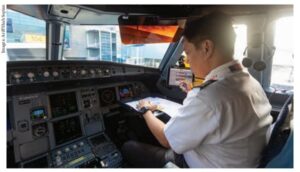
The Human Edge: Can Automation replace Human Pilots?
From self-driving cars to Al-powered chatbots, automation is everywhere. The aviation industry is no different. We’ve come a long way from the days of open cockpits and paper maps. Today’s modern airliners are marvels of automation, equipped with advanced flight management systems, autopilots and auto-thrust controls that can handle almost every phase of flight.
It’s no surprise that passengers often ask: “If the plane can fly itself, do we still need pilots?” While pilotless flight may indeed be possible in the future, for now the answer is clear. We still need human pilots, and here’s why.
The Automation Illusion
It’s true that most modern airliners can fly on autopilot from shortly after takeoff to a landing. But this paints only part of the picture. Automation excels at following pre-programmed instructions and performs brilliantly when everything goes according to plan.
However, real life, especially in the skies, often throws up the unexpected. Bird strikes, system failures, runway incursions or unexpected passenger medical emergencies are a few of the many variables that can instantly take a flight from routine to critical. In such moments, it is the trained instincts, experience and decision-making of human pilots that matter.
The Case For Human Judgment
Automation lacks the most vital ingredient essential to good aviation deci-sion-making: judgment.
Pilots are trained not only to fly the air-craft, but also to evaluate a rapidly changing environment, balance competing risks and make split-second decisions when faced with incomplete information. A computer may detect a failure, but it takes a human pilot to assess whether it’s safe to continue, divert, or declare an emergency.
Consider the famous case of US Airways Flight 1549 in 2009. After a bird strike disabled both engines, Captain Chesley ‘Sully’ Sullenberger and First Officer Jeffrey Skiles had only moments to act. The computers did not have a programmed strategy for ditching in the Hudson River. That came down to human skill and judgment. Their quick thinking saved all 155 lives on board.
Understanding The Limits Of Technology
Automation also requires oversight. The more reliable automated systems become, the more important it is to have someone monitoring them closely. Pilots remain engaged not just as backup, but as active managers of complex systems. They interpret what the aircraft is doing, anticipating potential issues and intervening when something does not seem right.
Autopilot can fly an aircraft, but it cannot negotiate with air traffic control during a sudden weather diversion, reassure nervous passengers, or manage an onboard emergency. These tasks call for leadership, communication and the composure of a trained pilot.
Training For The Unthinkable
In the simulator, pilots train relentlessly for worst-case scenarios: engine failures, hydraulic loss, electrical malfunctions and more. They are tested not just on technical handling, but on their ability to remain calm, coordinate as a team and prioritise tasks under extreme pressure. Soft skills like crew resource management, situational awareness and resilience remain beyond the reach of most computers.
Many passengers feel reassured by the sight of an uniformed pilot greeting them at the aircraft door. Pilots embody safety, responsibility and control. In an emergency, knowing there’s someone in the cockpit who has undergone years of rigorous training and has logged thousands of flying hours can make all the difference.
The Sky Needs Soul
Airplanes may be designed to fly on their own, but the sky is not an assembly line. It is a dynamic, often unpredictable environment. Pilots bring creativity and compassion to a field that, despite all its technology, remains very much human.
So, the next time you’re cruising at 35,000 feet and hear that familiar voice from the cockpit saying, “Ladies and gentlemen, this is your captain speaking,” remember you’re not just in the hands of machines. You’re in the hands of a professional trained to expect the unexpected. And that’s something no autopilot can replace.
View a YouTube video ‘Will AI Replace Pilots? A Captain’s Take.’
here https://www.youtube.com/shorts/71Hs33uIdbM