URBAN AIR MOBILITY
This article is about air taxis and how they’ll change city travel.
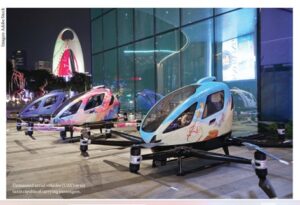
Imagine stepping out of a gridlocked traffic jam, riding an elevator to a rooftop vertiport, boarding a quiet electric aircraft, and arriving across town in a fraction of the time it would take by car. That is the promise of Urban Air Mobility (UAM), often referred to as air taxis, a new mode of transportation built around small electric vertical take-off and landing aircraft or eVTOLs.
Urban Transport Solution
Designed for short, on-demand urban journeys, UAM aims to move people and goods efficiently above crowded city streets.
Major prototypes are already flying, certification programmes are underway, and regulatory frameworks are being shaped in cities such as Dubai, Singapore, Paris and Los Angeles. The question is no longer whether air taxis will arrive, but when and how they will fit into everyday urban life.
Air taxis are not conventional helicopters. Most are electrically powered, producing far less noise and zero direct emissions.
Companies such as Joby Aviation, Archer Aviation, Volocopter and Lilium are developing sleek, multi-rotor or tilt-wing aircraft capable of carrying two to six passengers.
These vehicles are optimized for short, point-to-point flights – connecting airports to city centers, linking business districts with suburban hubs or crossing natural obstacles such as rivers and hills where ground transport is inefficient.
Potential Impact & Benefits
The potential impact on urban travel could be significant. The most immediate benefit is time savings, particularly along congested routes poorly served by existing public transport. Airport transfers, cross-city commutes and urgent business trips could be reduced from hours to minutes.
By diverting even a small percentage of travelers into the air, UAM could also ease pressure on overloaded road networks.
Because eVTOLs take off and land vertically, they require only compact infra-structure. Small vertiports located on roof-tops, transport interchanges or dedicated ground sites can serve as hubs for boarding, charging and maintenance. These facilities can be integrated into existing urban structures rather than requiring large, new airports.
How Air Taxis Work
Behind this vision lies a convergence of advanced technologies. Air taxis rely on lightweight high-density batteries, efficient electric propulsion and refined aerodynamics. Unlike helicopters, they have fewer moving parts, making them quieter. Many designs incorporate redundant systems to enhance reliability. In the longer term, autonomous or semi-autonomous flight systems, supported by artificial intelligence, are expected to reduce pilot workload.
Managing large numbers of aircraft at low altitude presents its own challenge. To address this, aviation authorities and organizations such as the National Aeronautics and Space Administration (NASA) are developing automated urban air traffic management systems capable of safely coordinating hundreds of simultaneous flights while avoiding buildings, obstacles and conventional aircraft.
Concept To Certification
Despite the promise, significant hurdles remain. Safety certification is paramount and necessarily slow, as regulators must ensure that eVTOLs meet stringent standards before carrying paying passengers. Noise, although reduced, remains a concern beneath flight paths. Infrastructure development, public acceptance and integration with existing transport systems will require careful planning.
Cost is another factor. Early services are likely to be expensive, positioning air taxis as a premium option similar to executive ground transport. Over time, however, economies of scale, technological improvements and competition could lower prices, bringing UAM closer to mainstream use.
Pilot Projects To Public Transport
The rollout will be gradual. Most experts expect the first commercial operations to begin between 2026 and 2028, focusing on specific high-value routes such as airport transfers. Dubai is widely expected to be among the first cities to launch limited services. For the foreseeable future, air taxis will complement rather than replace existing public transport.
UAM represents more than a new type of vehicle; it is a reimagining of how cities move. By introducing a third mode to transportation planning, it offers the prospect of faster, cleaner and more flexible urban travel. While a sky filled with air taxis may still be years away, the descent of this future is already underway.
*This article is featured in the March 2026 issue of AirAsia’s in-flight magazine redcap.
See YouTube video on
The Future of Transportation: Urban Air Mobility Systems
here https://tinyurl.com/ekuc3hmy