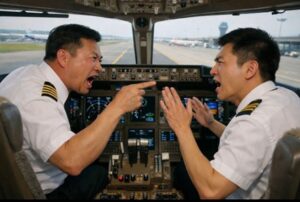
AI-generated illustration, not an actual photo
Why Assertive Support Process Training Matters
Crew Resource Management (CRM) has long been recognized as a cornerstone of safe flight operations. A key element of CRM is the Assertive Support Process (ASP), which empowers first officers to speak up and take decisive action when they perceive danger. Recent reports in the Taipei Times highlight an incident that underscores just how critical these protocols are in real-world cockpit scenarios.
History reminds us of tragedies—such as Tenerife, United Airlines Flight 173, and Korean Air Flight 801—that could have been prevented if structured communication and assertive escalation had been in place. ASP training ensures that co-pilots are not only encouraged but equipped to intervene when safety is at stake.
Role-playing exercises in classrooms and simulators remain some of the most powerful tools for embedding this mindset. They allow crews to practice voicing concerns under pressure, escalating warnings appropriately, and—when necessary—taking control to protect lives.
According to reports, the incident occurred after the flight’s Malaysian first officer attempted to warn the Taiwanese captain that the aircraft was taxiing above the recommended speed limit of 30 knots. After alerting the captain several times without success, the first officer manually applied the brakes in accordance with standard operating procedures.
The captain reportedly took offence at this intervention and allegedly punched the first officer at least four times, leaving him with swelling and bruising on the back of one hand.
Coincidentally, Malaysian first officers are generally well regarded and sought after by many Eastern and Middle Eastern airlines for their willingness to challenge authority when flight safety is concerned.
In a statement issued by the airline, it said that an investigation was launched. The airline stated that data retrieved from the aircraft’s Quick Access Recorder (QAR) indicated the aircraft was complying with taxi regulations and was not exceeding speed limits.
ASP training follows a structured escalation protocol. First, the co-pilot alerts the captain to the danger. If ignored, the warning is escalated with greater urgency. If the aircraft is below 1,000 feet and a serious error remains uncorrected, the co-pilot is trained to take control.
For example, if a landing appears unsafe, the co-pilot might say, “Captain, I recommend a go-around.”
If there is no response, this escalates to, “Captain, you must listen—go around now!”
And if still ignored: “I have control—going around now!”
Incidents like the one reported remind us that safety is not just about technical skill, but about communication and assertiveness in the cockpit. As aviation continues to evolve with new technologies and diverse crews, the question remains: how can we further strengthen CRM and ASP training to ensure every voice is heard when safety is at stake?
See a video on ‘Fist Fight in Cockpit’ here https://share.google/FryO8cjB84Cu0m07N