BATTERY SAFETY IN THE CABIN
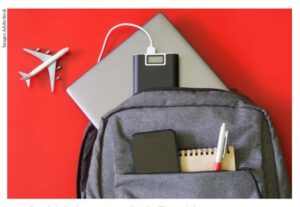
Why lithium battery fires in the aircraft cabin are dangerous and why you should stay informed.
A small power bank, a loose battery or a damaged phone – ordinary items we carry every day – can suddenly become a serious hazard at 35,000 feet. Lithium-ion batteries store a lot of energy in a tiny space. If they’re damaged, defective or short-circuit-ed, they can go into thermal runaway: cells overheat, vent flammable gases and ignite neighboring cells.
New Regulations
When this happens, the result is intense heat, thick toxic smoke and fire that’s hard to put out with a single puff from a standard extinguisher. This is why airlines and regulators consider lithium-battery fires as one of the most significant fire risks in the cabin.
Recently, a fire believed to have started from a power bank in an overhead locker forced an emergency response on a Virgin Australia flight. Cabin crew successfully extinguished the blaze, and the aircraft landed safely with no major injuries reported.
In response to similar incidents, regulators have tightened rules around lithium batteries. A single failing battery can escalate into a full cabin emergency.
Putting Out The Fire
Fighting a lithium-battery fire is a two-step process that involves extinguishing visible flames and cooling the adjacent cells to stop thermal runaway. Halon or other clean-agent extinguishers can often suppress open flames, but won’t stop the chemical reaction occurring inside the battery. Cooling, often with water, is needed to bring cell temperatures down.
Modern cabin procedures therefore combine halon, water and specialised tools such as fire-containment bags designed to isolate and cool a device while limiting oxygen exposure. Crew training now emphasises quick removal of the device into an empty, controlled area, aggressive cooling, smoke management, passenger protection and close coordination with the flight deck.
Battery Rules
AirAsia’s guidance is clear: spare lithium batteries and power banks must be carried in carry-on baggage only – never checked in. These items must never be stored in overhead compartments. The primary reason is accessibility. If a fire starts in an overhead bin, crew access can be delayed.
Devices stored under the seat in front of you are within arm’s reach, allowing passengers or crew to spot and respond immediately to any signs of overheating or smoke.
In addition, battery terminals must be properly insulated. Devices with non-removable batteries have strict watt-hour limits and in-flight charging of power banks is prohibited. Recently, AirAsia tightened these rules further, restricting both the use and charging of power banks onboard. For larger batteries (typically those between 100 Wh and 160 Wh) airline approval is required and quantities are limited. Storing spare batteries in checked baggage and charging power banks during flight are expressly forbidden.
The Cost Of Non-Compliance
Carriage of dangerous goods contrary to regulations is a serious offence. In Malaysia, operators and individuals who breach battery carriage rules may face heavy penalties, including fines, and in serious cases, prosecution. Malaysian aviation legislation provides for substantial fines and possible custodial sentences for offences that endanger aircraft or passengers.
Beyond legal consequences, non-com-pliant items may be confiscated, and passengers may be denied boarding. Airlines may also impose their own sanctions. If you are unsure whether an item requires approval, always declare it before travelling.
Dos and Don’ts Of Battery Safety
* Keep spare batteries and power banks in your carry-on baggage and ensure terminals are protected.
* Never place phones, e-cigarettes or power banks in checked baggage.
* Do not charge power banks onboard and avoid using damaged batteries or uncertified chargers.
* If a device feels hot or emits smoke, alert a crew member immediately.
Small Actions, Big Impact
Air travel remains remarkably safe, but that safety depends on small, everyday habits. Treat batteries with care: carry them correctly, use certified products, and follow airline instructions. A little caution on the ground can prevent emergencies in the air.
*This article is featured in the February 2026 issue of AirAsia’s in-flight magazine redcap.
Check out this video, “youtube video battery fire in aircraft cabin” https://share.google/7K824ntPHQ6zAYr7I
Check out this video, “youtube video battery fire in aircraft cabin” https://share.google/4R4iRyo6VVMnbQz33