PRECISION LANDINGS – most memorable and adrenaline-fueled runway approaches.

Step into the cockpit and view the most memorable and adrenaline-fueled runway approaches.
Navigating the skies is no mean feat, particularly when presented with challenging terrain, dense urban environments and unpredictable weather. But it’s all in a day’s job for the skilled pilots who fly these routes. Here are my top three picks for Asia’s most memorable approaches.
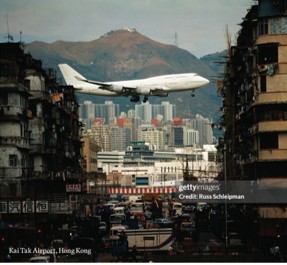
Wild Ride Into Kai Tak
Before Hong Kong’s Chek Lap Kok Airport opened in 1998, there was Kai Tak, a legendary airport that tested even experienced pilots. Landing there was unlike anywhere else.
You couldn’t fly straight in on Runway 13 – mountains and buildings blocked the way. Instead, pilots followed a unique Instrument Guidance System (IGS), which pointed them toward a giant orange-and white checkerboard painted on a hillside. At just 700 feet up, you had to make a sharp 47-degree turn manually, with no autopilot. One mistake meant missing the runway or clipping rooftops!
Kai Tak sat squeezed between mountains and the harbor. The approach took you low over the city, close enough to see into apartment windows. There was only one runway, jutting into the harbor – no backup, no room for error. The surrounding hills caused sudden crosswinds and turbulence, making the final approach a real struggle with the controls.
Landing there was a milestone; pilots wore a successful landing like a badge of honor. My first attempt wasn’t perfect, but it remains one of the most thrilling moments of my career. When the new airport opened, we felt relief but secretly missed the adrenaline.
Kathmandu: Airport In A ‘Bowl’
Landing in Kathmandu is an experience where the scenic but complex topography becomes part of the challenge. Tribhuvan International Airport sits inside Kathmandu Valley, ringed by the dramatic foothills of the Himalayas.
For pilots, this means careful planning and sharp navigation every time. The standard approach involves a fairly steep descent and requires special training and certification. Better-equipped crews can fly the RNP-AR approach, a highly precise, computer-guided path that winds through the surrounding valleys and mountains toward the runway.
From the cockpit, the view is stunning. As the plane descends, the valley opens up below like a natural amphitheater, with hills rising on every side. On clear days, some of the world’s tallest peaks appear on the horizon. Passengers might spot Kathmandu’s ancient temples – including the famous Swayambhunath Stupa – scattered across the valley floor.
But for the flight crew, all that beauty comes with a warning: stunning scenery sometimes means dangerous terrain. Every turn, every altitude change, every second of the descent must be tightly controlled. Kathmandu is an approach where precision, preparation and teamwork are absolutely essential.
Fukuoka: Airport In The City
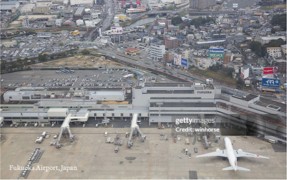
Fukuoka offers a completely different kind of thrill. Unlike most major airports, which sit far from downtown, Japan’s Fukuoka Airport is remarkably close to the city centre.
One of the most memorable moments is the visual approach to Runway 34R, which involves a tight circling turn with the entire city spread out beneath the wings. Passengers on the right of the aircraft often get a spectacular view as the plane banks sharply and lines up with the runway.
There’s plenty to see along the way: Fukuoka’s skyline, Hakata Bay, the coastline and neighborhoods stretching almost to the runway’s edge. Landmarks like Fukuoka Tower and the bay’s waterfront make it easy to appreciate just how close this airport sits to the heart of the city.
For pilots, though, this isn’t sightseeing – it’s serious work. Flying accurately through a tight, densely populated space demands precise visual flying, careful speed and altitude control, and constant coordination between both pilots. What looks like an effortless, graceful turn to passengers is, in reality, a carefully rehearsed maneuver.
Two Skies, Two Challenges
Kathmandu and Fukuoka showcase two very different faces of flying. One is shaped by mountains and valleys, the other by a dense, sprawling city hugging the runway’s edge.
For passengers, both approaches offer unforgettable views. For flight crews, they represent something more: a chance to blend technical skill, quick judgment and teamwork against some of the most striking landscapes in commercial aviation.
This article is featured in the November 2026 issue of AirAsia’s in-flight magazine redcap.
For more stories, kindly read my latest book, A Pilot’s Story. More details are found here www.askcaptainlim.com/pilots-story