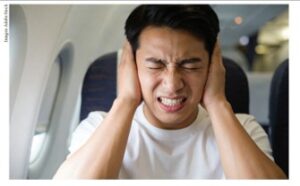
AIRPLANE EAR EXPLAINED Why our ears ache or ‘pop’ just before landing.
If you’ve ever felt a sharp ache or uncomfortable pressure in your ears as an aircraft begins its descent, you’re not alone. For many travelers, this moment that often occurs just before landing can be more ‘memorable’ than the flight itself. The good news is that ear discomfort during descent is common, well understood, and usually easy to manage.
Air Pressure
The real culprit behind earache is not altitude itself, as commonly believed, but changes in air pressure. As an aircraft descends, the outside air pressure increases significantly. Although modern aircraft cabins are pressurized, the cabin pressure still rises gradually during descent to prepare passengers for landing.
Inside your ear is a small, air-filled space known as the middle ear. This is separated from the outer ear by the eardrum. For you to feel comfortable, the pressure in the middle ear must match the pressure in the cabin environment. This balancing act is controlled by the Eustachian tube, a narrow passage connecting the middle ear to the back of the nose and throat.
Why Descent Hurts
You may notice that your ears usually cope well during take-off but become uncomfortable during landing. This is because pressure changes affect the ear differently in each phase of flight.
During climb, cabin pressure decreases, allowing excess air in the middle ear to escape easily through the Eustachian tube. The opposite happens during descent: pressure outside the ear increases and air must flow into the middle ear to equalise it. This requires the Eustachian tube to open actively – and that doesn’t always happen smoothly
When the tube remains partially blocked, pressure builds up across the eardrum, causing the familiar sensations of fullness, muffled hearing or pain.
Who Feels It More
Some people are affected more than others, particularly if they have conditions that make it harder for the Eustachian tube to open properly. These conditions include nasal congestion or allergies, colds, flu or sinus infections, and mild ear infections. Fatigue and dehydration can also affect the function of the Eustachian tube.
Children and babies are especially prone to ear discomfort because their Eustachian tubes are narrower and more horizontal, making pressure equalization more difficult. This is why infants often cry during descent – it’s discomfort they cannot explain.
Why Sweets Help
Many frequent flyers may remember in the past when cabin crew distributed sweets just before landing. This wasn’t simply a gesture of kindness – it had a practical purpose. Swallowing and sucking help open the Eustachian tubes, allowing pressure to equalise naturally. Chewing gum works in the same way, which is why it remains a popular travel essential.
What To Do

Most ear discomfort can be prevented or reduced with a few easy techniques:
- Swallow frequently during descent
- Chew gum or suck on sweets
- Yawn gently to open the Eustachian tubes
- Stay awake during descent
- Try a gentle Valsalva manoeuvre: pinch your nose, close your mouth, and blow gently (never force it)
- For babies, feeding or using a pacifier during descent can help
Take Extra Care
Flying with a heavy cold or blocked nose can make pressure equalisation difficult and, in rare cases, lead to more severe ear pain or temporary hearing problems. Frequent flyers and pilots often avoid flying when feeling significantly congested, or use doctor-recommended nasal sprays before descent.
Earache during descent is simply your body responding to changes in air pressure – a natural consequence of flying at high altitude. With a little awareness and a few simple habits, most passengers can land comfortably, ready to enjoy their destination.
A PILOT’S STORY, Captain Lim’s third book takes off on June 2026. Preview now at https://www.askcaptainlim.com/pilots-story
*This article is featured in the June 2026 issue of AirAsia’s in-flight magazine redcap.